Soft robotic grippers

Robotic grippers cut from a single sheet.

Kirigami turns one simple pull into a gentle, precise grasp, with no motors or sensors at the fingertip. Cheap enough to be disposable. Gentle enough for a raspberry. Built on patented research from Boston University.

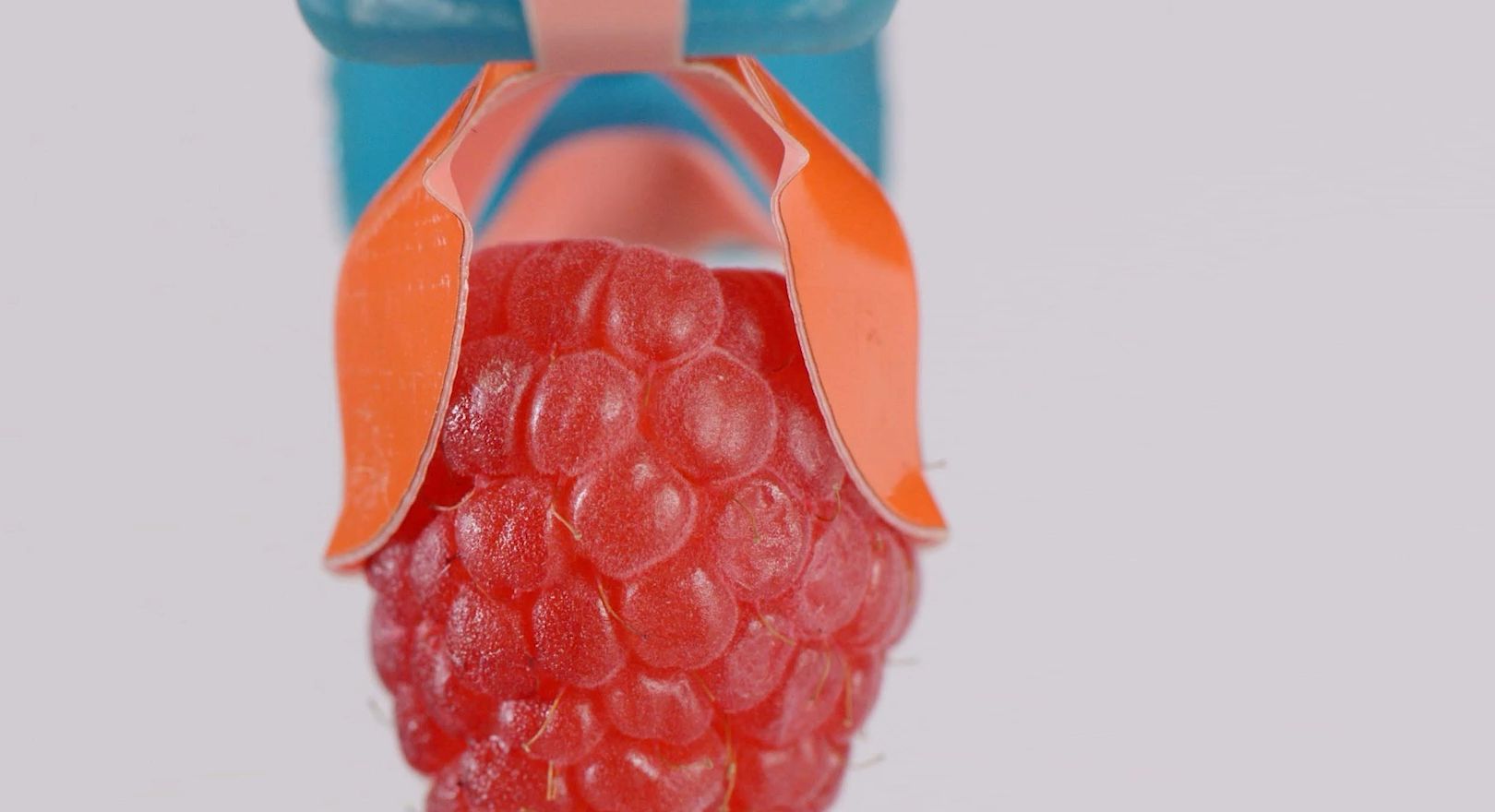
Close-up of an orange kirigami gripper, two thin curved plastic flaps, pinching a whole raspberry without crushing it.
Video still · Holmes Lab, Boston University
Plan view: a flat sheet with curved cuts is pulled from both ends, and the cuts open. Plan Section view: as the sheet is pulled, it buckles out of plane and its flaps close around an object. Section A–A
0%
Published
Science Robotics (2021), Yang, Vella & Holmes
Patented research
US Patent 10,933,539, Boston University
Lab
Holmes Lab, Boston University

Technology

One pull. The cuts do the rest.

Soft grippers today usually need air lines, cables or complex controls. Kirigami is a flat sheet: cheap to make, light, and easy to add to robots people already own.

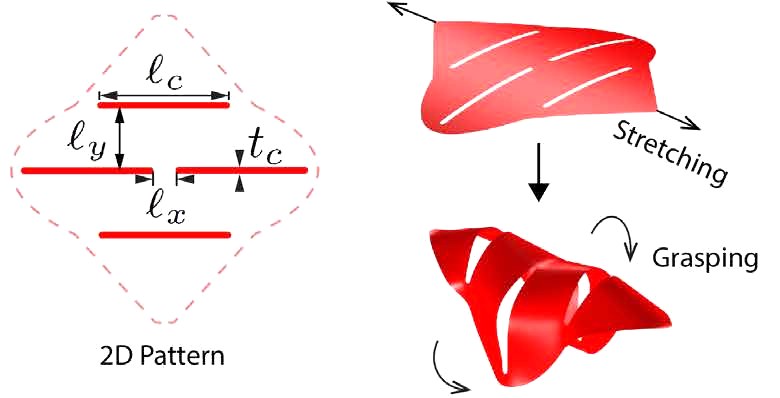
Diagram of the kirigami unit cell: a flat pattern of four parallel cuts inside a rounded outline, and a red shell that stretches and then curls into a grasping shape.
Flat cut pattern (left) and the shell it becomes when stretched (right). Image: Yang, Vella & Holmes, Science Robotics (2021), Holmes Lab, Boston University.
  1. 01

    Cut

    A precise pattern is laser-cut into a thin plastic sheet.

  2. 02

    Pull

    Stretching the sheet makes it buckle out of plane.

  3. 03

    Grasp

    The flaps close around an object, gently and repeatably.

What the research demonstrated

Yang, Vella & Holmes, Science Robotics (2021)

Actuation
One pull on the sheet, or a magnetic field (wireless)
Control at the grip
None. The grasp comes from the geometry of the cuts.
Mounting
Attached to a standard two-finger robot gripper
Materials tested
Thin PET plastic; silicone with iron particles (magnetic version)
Size range
Grain of sand to wallet
Parallel grasping
24 objects in one motion (8×3 array)
Response time
~60 ms (magnetic version, underwater)
Holding force
About 0.3–0.8 N in lab-scale tests on spheres a few millimetres across

Results

What the research has shown

Scale

Grain of sand → wallet

One design scales across sizes.
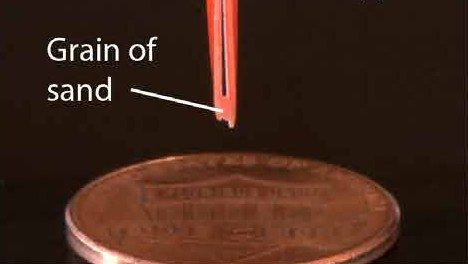
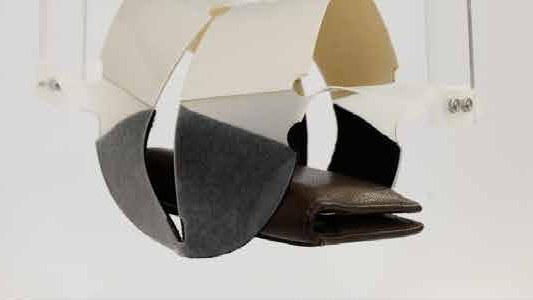
Left: a scaled-down gripper holding a grain of sand. Right: a hand-size gripper holding a wallet. Image: Yang, Vella & Holmes, Science Robotics (2021), Holmes Lab, Boston University.

Parallel

24 objectsin one motion

An 8×3 gripper array picks and places them together.

Lab footage
The gripper array moving a full set of spheres between trays. Video: Holmes Lab, Boston University.

Speed

~60 ms

A magnet-driven version caught a falling object underwater, wirelessly.
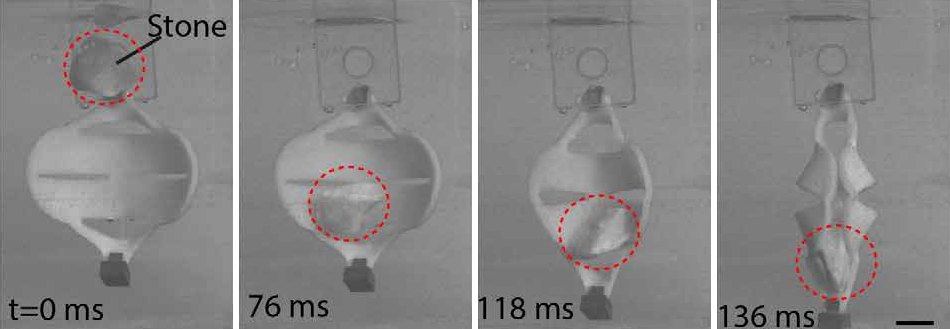
Four high-speed camera frames, from 0 to 136 milliseconds, of a magnet-driven kirigami gripper underwater closing around a falling stone, circled in red.
High-speed frames of a falling stone being caught underwater. Image: Yang, Vella & Holmes, Science Robotics (2021), Holmes Lab, Boston University.

Control

No feedback control

The grasp comes from the geometry of the cuts.

Lab footage
A kirigami shell on a standard two-finger robot gripper, picking and placing a raspberry. Video: Holmes Lab, Boston University.

Results from Yang, Vella & Holmes, Science Robotics (2021).

Dual use

One mechanism. Three markets.

We’re starting where the research already shows the gripper’s strengths, and where buyers already own the robot. We make the part that touches the object.

A · Defense and public safety

Clip-on grippers for bomb-disposal and hazmat robots

Who it’s for

Military EOD units, police bomb squads, hazmat teams, nuclear and chemical site operators

Why it fits

  • Fits robots teams already own. The research mounted it on a standard robot gripper.
  • Handles fragile or unstable objects without crushing them.
  • Cheap to replace, instead of risking a person.
  • No electronics at the grip.

What we’re asking operators

What sizes and weights do your robots need to hold, and what do they drop or crush today?

B · Commercial

Gentle automation for food handling and packaging

Who it’s for

Food packaging lines, produce packers, agricultural robotics teams

Why it fits

  • Delicate produce and irregular items that rigid grippers bruise or drop.
  • Shown picking a raspberry without crushing it.
  • An array placed 24 objects in one motion.
  • Low-cost, replaceable contact parts.

What we’re asking engineers

Where do your current grippers bruise, drop or slow down product, and what does that cost per shift?

C · Biotech and life sciences

Single-use grippers for delicate biological samples

Who it’s for

Lab automation teams, cell and tissue labs, pharmacy and medical-device manufacturers

Why it fits

  • Shown handling soft hydrogel spheres, one at a time and in arrays.
  • Scales down to a grain of sand.
  • A hand-held version picked up a medical pill.
  • The paper describes the design as material-independent, so it could be cut from biocompatible films. Not yet tested.
  • Cheap enough to be single-use.

What we’re asking scientists

What do you still move by hand because robots damage, drop or contaminate it?

Also exploring

Evidence tags show what the research has demonstrated so far

Underwater sampling

Ocean science teams, naval underwater vehicles

Shown in research

A magnet-driven gripper caught a falling stone underwater in about 60 ms, with no wires.

Surgical and medical tools

Medical-device and surgical teams

Early idea

Longer term. Use inside the body needs biocompatible materials, sterilization testing and FDA clearance.

Drone payloads

Delivery, inspection and sensor-drop drones

Early idea

Light and wire-free, but not yet tested on a drone.

Space

Satellite servicing and in-orbit assembly

Early idea

Ships flat and weighs little. Would need space-rated materials; the paper describes the design as material-independent.

Customer conversations

Help us build the right gripper.

We’re early: building prototypes and talking with bomb-disposal teams and food automation engineers. If either describes you, we’d love 15 minutes.

We’re not selling anything yet. We want to learn where today’s grippers fail you.

  1. What do your robots or operators struggle to pick up today?
  2. What happens when a grip fails, and what does that cost?
  3. How often do you replace or swap grippers and end-effectors?
  4. What weight, size and environment would a gripper need to handle?

Book 15 minutes

Tell us a little about your work. Sophia will reply by email.

Or email sophiavw@bu.edu

Received

Thanks. Sophia will be in touch.

If it’s urgent, email sophiavw@bu.edu.

Team

Who’s building it

Sophia Wong

Founder

Electrical Engineering at Boston University. Background in EEG hardware and signal processing; research at Harvard’s Kempner Institute and UC Davis. Previously at XiberLinc, a Berkeley SkyDeck startup. Incoming Amazon SDE Intern.

Working with the Holmes Lab at Boston University.